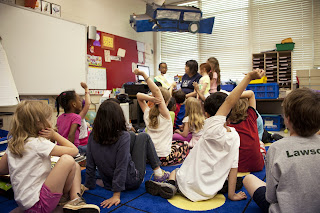
Showing posts with label team. Show all posts

Wednesday, April 20, 2022

Attempts are Important

In The worst from Seth Godin's Blogby Seth Godin states

“The worst golfer doesn’t even play.”

I remember talking to a high school basketball player and asking him if he got nervous when he tried to make a basket. Wasn’t he afraid that he would miss? He just looked at me with surprise. Then he let me know that he would never make a basket if he never tried. Better to try and miss than to never try at all.

This is what I want my students to learn in my class. I want them to be willing to try even if they might make a mistake.

I have watched students paralyzed with fear in case they make a mistake. They are afraid people will laugh at them and ridicule them. This has happened to them before and they have learned to protect themselves.

I start out by explaining everyone makes mistakes all of the time throughout their life. This is part of life and learning. We learn from our mistakes.

When a basketball player shoots for a basket and misses, he learns that the spot he aimed for was not the right spot. He keeps practicing until he finds the right spot. The right spot for him may not be the same spot for me because we are at different heights and have different strengths. When a player is practicing shots, does his team laugh at him when he misses? No, they encourage him to do better.

I want my students to be teammates. I want them to encourage each other and help them to be brave enough to try. I want my class to be a safe place where it is okay to make mistakes as long as we learn from them. I want to teach the students to be compassionate and understanding so they can help each.

When the class acts as a team and helps each other, everyone will be more successful.

How do you encourage your students to be a team? Please share.

Photo by Tom Briskey on Unsplash

Thursday, April 7, 2022

Obstacles are Not Catastrophes

In ​​Catastrophization from Seth Godin's Blog, Seth Godin states

“A catastrophe is a shared emergency that overwhelms our interactions and narratives”

Too many times, the education systems react to challenges as if they are catastrophes rather than challenges.

When this happens, we react instead of act.

I recently watched a TV show where the leader of a team kept telling them to “work the problem.” This reminds everyone to stop reacting and start acting. Look at the possibilities instead of the impossibilities.

This is important to teach my students. I want them to stop seeing every obstacle as if it is a catastrophe. When they have this mindset, I think it causes them to shut down and want to curl in a ball to protect themselves. This keeps them from moving forward.

I want my students to see each other as a teammate. When an obstacle arises, I want them to trust everyone to help them work the problem if they are unable to do it themselves. Once we understand the problem, we have them brainstorm different solutions. No idea is laughed at and all ideas are thrown out for consideration. Once all the ideas are exhausted, we can look at each one and see what the limitations or possibilities are in order to narrow it down to a possible solution.

When I first start this process, I start with a few of my own obstacles so the students understand the process. Once I can model how we do this and my students understand how helpful this is, I encourage each one to share an obstacle. The more we do this process, the easier it gets for some students to open up. They like having the support of others when we do this and sometimes others share that they have faced the same obstacle before. Some share how they handled it and how they wish they handled it differently.

This process is a very powerful strategy and has helped my students be more successful in the classroom and out of the classroom.

How do you help students face obstacles? Please share.

Photo by Tim Collins on Unsplash

Wednesday, March 9, 2022

SARCNET (a.k.a. School Amateur Radio Club NET)

(Guest Post: Jeffrey A. Meyer is a Radio Amateur and Model Railroader, and Retiree currently residing in Painesville, Ohio.)


SARCNET opens up the average classroom to an entirely new way to offer, conduct, coordinate and teach classroom STEM topics. They have accumulated fun, relevant, and practical lesson plans to teach elementary school-aged kids STEM topics for grades 3-6.

If your school doesn’t have something like this, your kids are really missing out. You also need to know that there are less than fifty programs like this in elementary schools nationally.

First and most importantly, I’m not here to tell you how to manage your classroom or how to practice your craft. You are the professionals, it’s your territory and you deserve both the praise and the respect that goes along with that level of responsibility.

TEACH ALONE OR AS A TEAM?

What I am proposing is that you don’t always have to do all the teaching alone. By approaching some teaching opportunities as a team, the employed teacher doesn’t have to be the subject matter expert, so the “other half” of the team could actually be recruited from hobbyists in Amateur Radio, Model Railroading, etc., as well as aviation and a host of other interesting STEM relevant professions.

Now take this tag-team approach and designate the non-teacher to be a local Amateur Radio hobbyist. The Radio Amateur would bring the needed practical side of the hobby, i.e. radio science, electronics, kit and antenna building, propagation, communication skills, project management, decision making, etc.

This collaborative approach, coupled by using a hobby (Amateur Radio), to explain and supplement classroom learning, is exactly what we are talking about. This is SARCNET.

HISTORY

SARCNET started back in 2015 when an elementary school librarian noticed some kids weren’t interested in playing kickball at lunchtime and thought these kids may be more interested in doing something else. Being a Radio Amateur herself, she brought her radio in, introduced it to the kids and SARCNET was born. What started out as an easy lunchtime diversion, has now expanded to six schools and two countries with a host of lesson plans and activities that are pure genius.

The kids learn Morse Code, radio communication protocols, assemble electronic kits, talk to the entire world, seamlessly learn geography, build solar and microcontrollers to both monitor power output and control plant growth, build antennas, search for sources of radio interference, locate hidden transmitters (aka “Fox Hunts”), manually track satellites, etc…..

The kids love it, the parents support it and the principal (Michael Day, St. Kevin’s Primary School, Ormond, Victoria, Australia) had the following to say about it:

“It is interesting that in this day and age of mobile broadband networks and social media that Amateur Radio, the pioneering radio hobby of the last century, would be an excellent way of introducing science and technology to young children today. Amateur Radio enthusiasts are an amazing, untapped resource for educators. They are hidden away in every community and can provide their own equipment and expertise. They also have a zeal to pass on this technology to the next generation. So this largely free and enriching collaboration, between the schools and the Amateur Radio fraternity, is a classic win-win situation.

When I first introduced the school Amateur Radio club at St. Kevin's Primary School in Ormond Victoria, I had no idea what a success it would be. We were lucky to have an Amateur Radio enthusiast within our ranks, so the introduction was initially driven by this staff member. The teachers, parents, and students are now raving about it. To see the children confidently building electronic kits or talking to other schools over shortwave radio is quite incredible. I am now exploring ways to expand this program. The following article, by Julie and Joe Gonzales, (our staff member and her husband) introduces the modern world of Amateur Radio. It explains how they set up Amateur Radio clubs at three primary schools in Melbourne and it provides all the information needed for other schools to get involved.“

ANOTHER ELEMENTARY SCHOOL USING AMATEUR RADIO IN THEIR STEM CURRICULUM

Now let’s turn to W. B. Beam Intermediate School in Cherryville, NC, and what they started in 2021. One of the school’s 4th-grade teachers there, Mark Reep, is also a Radio Amateur and he set up an Amateur Radio Club. I personally spoke to him in February of 2022 and with a total school enrollment of 200 students, he already has 77 of them actively participating in it, right now. That’s nearly forty percent of the total enrollment!

Why are these programs so popular? Plainly speaking, the kids find the topics interesting, relevant, valuable, and most of all, fun. As a teacher, this is possible anywhere in the U.S. and why not in your school?

As a teacher, using a team approach can reduce your stress, better connect you to your community, is likely to be FREE of charge, and offers a win-win-win for everyone involved. By partnering with any hobbyist or other relevant occupational professional, it’s a win for you, a win for the volunteer, and most of all, a larger life-changing win for your kids.

After all, it does take a Village and both hobbyists and professionals are just waiting for the chance to help you and make a real difference for the kids.

Your Fellow Villager,
Jeffrey Meyer
Painesville, OH

Photo by CDC on Unsplash

Monday, January 24, 2022

Learning to Work Together

Working as a team is not something that comes naturally to most people. This is a skill that has to be taught. As we move into a world where many students are learning remotely from home, this skill becomes harder to learn. Specific lessons need to be planned where teamwork is expected and encouraged. Group projects should be planned where each person has a specific role to complete the project.

The teacher can group students according to unique strengths, common interests, or ability levels. Each group should be carefully formed and can be changed for different projects. Groups should be 3 - 4 people.

Projects should be carefully planned where there are specific tasks to be completed by different members of the group. The final goal should be clearly stated so students will know what is expected of them. In addition to the specific tasks for each member, there needs to be a Leader of the group to bring everyone together at the beginning and the end. There should also be a Timekeeper to make sure everyone is keeping on track according to the time allotted. In addition to those roles, there needs to be a Presenter who will present the final product to the class. If a fourth person is in the group, this person could be the Organizer who puts all of the parts together in order.

Students need to be taught how to come together and check on the progress of the project. They need to learn how to brainstorm and support each other when obstacles are encountered. They also need to learn how to give constructive criticism to each team member without offending the person. Then they need to learn how to bring all of their parts together to make the final product.

Rubrics work well for evaluating group projects and individual members of the group. I like to have each student self-evaluate using the rubric in addition to my own evaluation. This teaches students to look carefully at their own work and the group’s work as a whole.

How do you teach teamwork? Please share.

Photo by krakenimages on Unsplash

Thursday, September 23, 2021

Stop Wasting Time

In Respecting their time from Seth Godin's Blog, Seth Godin states,

“Synchronized, real-time interaction is precious. It creates magic. We shouldn’t waste it on bureaucracy or displays of false control–it’s better saved for moments of connection and possibility.”

One of the things I like about attending meetings on Zoom is that we can introduce ourselves in the chat window instead of going to each person and doing it one at a time. I think this really saves a lot of time and allows the meeting to move into the “meat” of why we are meeting. I hate wasting time and many times I feel like I could skip the first 10 minutes of a meeting because they go around and introduce themselves. Everyone giving their location and job title in the chat really moves things along. Another way to get this information is by taking a poll. This keeps everyone engaged at the same time.

Recently I attended a webinar and the presenter started her presentation. The first presentation slide was jam-packed with bullet points and words. There were so many words that I could barely read because the font was so small. I confess that I inwardly groaned. Then she started to read every word off the slide and I instantly shut down. I also confess that I left the meeting. I did not want to waste 50 more minutes with this person if this is how she began the meeting because I didn’t see the rest of the time being any more productive.

I need to treat my students with the same kind of respect. Their time is as valuable as my time. Instead of expecting my students to sit there and just listen to everything I want to say, I need to get them engaged. I need to make sure they want to stay engaged.

I like to put students in teams and team members have different roles like a Leader, a Collector, a Reporter, a Closer. I don’t want to waste precious class time taking care of attendance or collecting homework. The team leader can tell me if everyone in their group is there or who is absent. The collector can collect homework for the group and put it in a designated folder for me. I can also have the collector pick up materials to give to the team. During the lesson, the reporter can fill out any forms to turn in or prepare a presentation share. Before the class ends, I can have the Closer collect materials and put them back in a designated area. This cuts out a lot of wasted time.

One way to get my students engaged is by hooking them into the lesson. I want them to ask questions and want to know more. I want them to feel they have some control over what information we can find out. I want them to feel like the lesson is worth learning and not a waste of time because my students don’t have the option of leaving the class. They can mentally shut down and still be physically there but that will end up being frustrating for both of them. I need to make sure that this real-time interaction is meaningful to them.

How do you avoid wasting time in your class? Please share.

Photo by Nathan Dumlao on Unsplash


Monday, April 26, 2021

Team Work

Recently I attended a virtual education conference and one of the sessions was creative collaborative classrooms. One of the first things we learned was about individual roles in the team. I really like this because it gave each person some responsibility and it had nothing to do with ability. It let each person be an integral part of the team. I like that each team had four people on a team. If there are fewer, people can share the fourth role or someone can double up on a role. Each time the team meets, the roles can be rotated or kept the same.

Here are the four roles:
  • Resource Manager
  • Task Manager
  • Facilitator
  • Recorder/Reporter.
The Resource Manager is responsible for gathering, distributing, and returning all resources. This includes handouts and equipment. If the team needs the help of the teacher, this person will contact the teacher.

The Task Manager is responsible for keeping the team on track. If team members are off task or going off on a tangent, the Task Manager reminds them of the team’s purpose. The task manager makes sure that the job gets done and that everyone is included. Informing the team how much time is left until the deadline is important.

The Facilitator gets the team started. This person might restate the directions or read aloud the question. This person makes sure that everybody understands what the team’s objective is. Different parts of the task may be allotted out to different team members.

The Recorder/Reporter is responsible for all written or oral responses of the team. Once the team agrees to the response, the Recorder/Reporter writes down the answer(s). If the team is called about to share the response, this person is the one who shares it to the class.

You can randomly assign the roles or you can specifically assign which student gets each role. It depends on the abilities of your students. If all abilities are equal or unknown, I would assign them randomly. When deciding who gets which role, the team was instructed to go alphabetically by first names and then assign the roles in that order.

How do you handle teams in your classroom? Please share.

Photo by Annie Spratt on Unsplash

Tuesday, November 12, 2019

Working Together


“Have you attended a learning opportunity with others? If so, did you realize any of these benefits? Anything missing? What are some strategies you’ve put in place for successful team learning?”

I have mixed feelings about working in a group. Sometimes I like it and sometimes I don’t. Sometimes it works and sometimes it doesn’t.

When it works:
·      I enjoy the fact that I’m not alone.
·      I like that I don’t have all the responsibility.
·      One person is the leader and coordinates all activities.
·      One person makes sure that all parts are being completed in a timely fashion.
·      Each team member uses their individual strengths to work towards a shared goal.
·      Everyone pulls their weight.
·      If we run into an obstacle, we talk out the problem and come up with a solution faster.
·      It is successful if everyone completes their tasks.

When it doesn’t work:
·      Everyone wants to be the leader and take charge.
·      Everyone doesn’t pull their weight.
·      Not everyone in the group gets along because of personality conflicts.
·      When someone makes a mistake, they refuse to admit it.
·      I don’t like that I have to work on everyone else’s timeline. This might mean that I can’t do my part until someone else completes their part. If they don’t complete their part in a timely fashion, I can’t get my part done on time so we might miss a deadline.
·      Everyone blames someone else in the group for the group’s failure to complete the goal.

I think it is important that we teach students how to work in a group. This is not something that comes naturally and requires social skills. It is important to discuss what happens when it works and what happens when it doesn’t work. They need to see that working as a group is like working as a machine.

It would be great to bring in some kind of machine that you can remove a part or two. Show them how it works when all the parts are together. Then take out a part or two and see if it still works. Explain to the students that this is just like working as a group.

Working as a group or team is a job skill that everyone needs to learn. They don’t have to like everyone on their team but when they are on a job, they are required to reach the goal assigned and it doesn’t matter if they like each other.

How do you teach students to work in a group? Please share.

Photo by Quino Al on Unsplash