
Showing posts with label ham radios. Show all posts

Wednesday, March 9, 2022

SARCNET (a.k.a. School Amateur Radio Club NET)

(Guest Post: Jeffrey A. Meyer is a Radio Amateur and Model Railroader, and Retiree currently residing in Painesville, Ohio.)


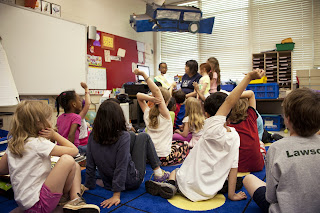
SARCNET opens up the average classroom to an entirely new way to offer, conduct, coordinate and teach classroom STEM topics. They have accumulated fun, relevant, and practical lesson plans to teach elementary school-aged kids STEM topics for grades 3-6.

If your school doesn’t have something like this, your kids are really missing out. You also need to know that there are less than fifty programs like this in elementary schools nationally.

First and most importantly, I’m not here to tell you how to manage your classroom or how to practice your craft. You are the professionals, it’s your territory and you deserve both the praise and the respect that goes along with that level of responsibility.

TEACH ALONE OR AS A TEAM?

What I am proposing is that you don’t always have to do all the teaching alone. By approaching some teaching opportunities as a team, the employed teacher doesn’t have to be the subject matter expert, so the “other half” of the team could actually be recruited from hobbyists in Amateur Radio, Model Railroading, etc., as well as aviation and a host of other interesting STEM relevant professions.

Now take this tag-team approach and designate the non-teacher to be a local Amateur Radio hobbyist. The Radio Amateur would bring the needed practical side of the hobby, i.e. radio science, electronics, kit and antenna building, propagation, communication skills, project management, decision making, etc.

This collaborative approach, coupled by using a hobby (Amateur Radio), to explain and supplement classroom learning, is exactly what we are talking about. This is SARCNET.

HISTORY

SARCNET started back in 2015 when an elementary school librarian noticed some kids weren’t interested in playing kickball at lunchtime and thought these kids may be more interested in doing something else. Being a Radio Amateur herself, she brought her radio in, introduced it to the kids and SARCNET was born. What started out as an easy lunchtime diversion, has now expanded to six schools and two countries with a host of lesson plans and activities that are pure genius.

The kids learn Morse Code, radio communication protocols, assemble electronic kits, talk to the entire world, seamlessly learn geography, build solar and microcontrollers to both monitor power output and control plant growth, build antennas, search for sources of radio interference, locate hidden transmitters (aka “Fox Hunts”), manually track satellites, etc…..

The kids love it, the parents support it and the principal (Michael Day, St. Kevin’s Primary School, Ormond, Victoria, Australia) had the following to say about it:

“It is interesting that in this day and age of mobile broadband networks and social media that Amateur Radio, the pioneering radio hobby of the last century, would be an excellent way of introducing science and technology to young children today. Amateur Radio enthusiasts are an amazing, untapped resource for educators. They are hidden away in every community and can provide their own equipment and expertise. They also have a zeal to pass on this technology to the next generation. So this largely free and enriching collaboration, between the schools and the Amateur Radio fraternity, is a classic win-win situation.

When I first introduced the school Amateur Radio club at St. Kevin's Primary School in Ormond Victoria, I had no idea what a success it would be. We were lucky to have an Amateur Radio enthusiast within our ranks, so the introduction was initially driven by this staff member. The teachers, parents, and students are now raving about it. To see the children confidently building electronic kits or talking to other schools over shortwave radio is quite incredible. I am now exploring ways to expand this program. The following article, by Julie and Joe Gonzales, (our staff member and her husband) introduces the modern world of Amateur Radio. It explains how they set up Amateur Radio clubs at three primary schools in Melbourne and it provides all the information needed for other schools to get involved.“

ANOTHER ELEMENTARY SCHOOL USING AMATEUR RADIO IN THEIR STEM CURRICULUM

Now let’s turn to W. B. Beam Intermediate School in Cherryville, NC, and what they started in 2021. One of the school’s 4th-grade teachers there, Mark Reep, is also a Radio Amateur and he set up an Amateur Radio Club. I personally spoke to him in February of 2022 and with a total school enrollment of 200 students, he already has 77 of them actively participating in it, right now. That’s nearly forty percent of the total enrollment!

Why are these programs so popular? Plainly speaking, the kids find the topics interesting, relevant, valuable, and most of all, fun. As a teacher, this is possible anywhere in the U.S. and why not in your school?

As a teacher, using a team approach can reduce your stress, better connect you to your community, is likely to be FREE of charge, and offers a win-win-win for everyone involved. By partnering with any hobbyist or other relevant occupational professional, it’s a win for you, a win for the volunteer, and most of all, a larger life-changing win for your kids.

After all, it does take a Village and both hobbyists and professionals are just waiting for the chance to help you and make a real difference for the kids.

Your Fellow Villager,
Jeffrey Meyer
Painesville, OH

Photo by CDC on Unsplash

Wednesday, March 2, 2022

Amateur Radio with the Blind and Deaf

(Guest Post: Jeffrey A. Meyer is a Radio Amateur and Model Railroader, and Retiree currently residing in Painesville, Ohio.)

Since its discovery in 1895, radio has always been on the cutting edge of technology and through the excellent work of both experimenters and hobbyists, our lives have been forever changed. Radio is so tightly woven into the fabric of our everyday life that we don’t know it’s all around us. From your remote car starter to weather radar, to your microwave oven and your smartphone, radio signals are everywhere.

Like many innovations, someone takes an existing concept, tweaks it, and applies it somewhere else. It’s that spirit that brought us from Radio to RADAR to Doppler Radar to being in your car to avoid accidents and keep you centered in your roadway lane.

Let’s now look at another branch of the radio’s family tree.

NASA needed a way to communicate with the MARS rover. Being a relatively tiny device, it could only use low power, so the transmitter and antenna had to be sized accordingly. So, the call went out looking for a solution. What came back was a software program that could “hear” nearly inaudible radio signals, signals that were so weak they were simply buried deep within the noise and static.

Fast forward to today.

Now, imagine that you are blind or deaf. How would you do many of the things the rest of us do so easily? Getting around is difficult, which complicates meeting new people, and that doesn’t include the loneliness, isolation, and occasional need to have to depend on others.

What if there was a way to meet new people, learn new things and get some serious relief from those daily problems?

Voila! There is and it’s called Amateur Radio. If they’ve ever heard of Ham Radio at all, they think it’s an ancient and boring hobby for old men. Not even close.

Today, our radios talk to us, so you don’t need to be sighted, and now, you can have a conversation with stations that you can’t even hear. Additionally, you can compete in contests that match your operating skills with others, or just simply kibbutz.

In essence, you can armchair travel anywhere your signal takes you, earn operating awards, such as working all continents, pass radio messages for people, participate in public service events, play chess over the air or contact new countries, any time of the day or night.

No other hobby or activity, on the planet, levels the playing field more for the disabled. If it’s a problem, smart minds and a supportive team can get past it.

We have Handihams, an organization that creates and provides podcasts, training materials in every format, local clubs that really want your participation, and an army of “Elmers” that will volunteer their time, talents, and resources to get you on the air. It really does take a village and this is it.

Most people don’t know that today’s weathercasters can’t actually identify the altitude where the rotation is. The rotation could be anywhere from the ground to the cloud, so they need “spotters” who know what to look for. For as long as I can remember, Hams have been the eyes and ears of the NWS and the blind and deaf can easily participate in that too.

So, if you’re disabled or know someone who is, let them know that there is an avenue for them to participate, learn, grow and benefit from. It could be in the areas of public service and so much more.

Finally, I’ve been personally involved in this hobby for over 45 years now and say this with absolute certainty; there’s always something new to experience, no two days are ever alike and it never gets boring. It’s like a good friend with infinite possibilities.

Come and join us, you’ll be glad you did.

Photo by Matt Seymour on Unsplash

Monday, February 21, 2022

Amateur Radio as a Stem Classroom Tool

(Guest Post: Jeffrey A. Meyer is a Radio Amateur and Model Railroader, and Retiree currently residing in Painesville, Ohio.)


We’ve come a long way since 1895 when the radio was first “invented”. That continuing radio-based research resulted in both AM and FM radio, RADAR of all kinds (police and weather too), the microwave oven, the television remote, mobile phones, and everything wireless. Today, radio is so prevalent that we get our news and weather on TV, radio, and smartphones, our cars nearly drive themselves, we can turn on our house lights remotely, keep our pets contained, heat up our meals, follow our kids on daycare cameras, order our favorite fast food at the drive-thru, etc.………..

Now, let’s look at how a 125 plus-year-old association with radio continues to offer an unrivaled STEM learning opportunity for today’s students.

SCIENCE (PHYSICS)

Amateur Radio revolves around sending and receiving radio waves, and to do so, students will learn about the earth’s atmosphere, basic electricity, sunspots, meteorology, Ohm’s Law, radio theory, and weather.

MATHEMATICS

This hobby involves the metric system and is comprised of many mathematical formulas, from calculating dimensions to building antennas to plotting a top view 3D picture of how an antenna actually works in space.

ELECTRONICS TECHNOLOGY

Electronic circuits are created by connecting different combinations of electronic parts, so the student will learn what these parts look like, what they do, be able to identify them in a schematic diagram, participate in both assembling and wiring projects, learn how to solder and how to do all of this safely.

COMPUTER SCIENCE

Today, our computers talk to our radios, which means we can control them remotely or in your home radio room. This software can change both their frequencies and modes, control where we aim our antennas to exactly towards where we want to talk, record our contacts directly into our station logs, dispatch that contact information to websites for awards and even enable us to design our own proof of contact postcards.

COMMUNICATION ARTS & FOREIGN LANGUAGES


Through Amateur Radio, the student is able to sharpen both their conversational and listening skills. Broadening one’s horizons, through meeting and engaging with other people and cultures, is an important aspect of everyone’s personal growth. Those activities help all of us to better understand the world around us and learn the important art of being a patient listener. In addition to that, foreign language broadcasts can also be used to fill the gap between the “King’s English” and everyday conversation.

GEOGRAPHY

There is no better hobby or activity on earth that addresses this topic better than Amateur Radio. As signals are traveling all around the world 24/7/365, you will ALWAYS hear foreign amateur stations. Without having Amateur Radio, in my life, I wouldn’t readily know where specific countries are located, which continent they are in, or be able to answer that Final Jeopardy question that no one else knew.

I’ve shown you that radio is more relevant than ever, given you just a small sampling of examples, where radio activities intersect with STEM instruction and demonstrated how a simple hobby easily brings the non-textbook, practical side of problem-solving into your classroom environment.

Finally, programs like this are rare enough that there are less than fifty schools nationally doing something similar, with some states having none at all. That being said, there are plenty of opportunities out there to blaze a new trail and use this hobby as a unique launching pad for your kids, so why not with your school and why not now? Do you see the potential? Check out SARCNET at www.sarcnet.org. and you’ll see what I mean.

Let’s collaborate on this, you’ll be glad we did.

Wednesday, February 9, 2022

School Amateur Radio Club Network

I was recently contacted by someone who wanted me to reach out to educators and tell them about the  SARCNET - School Amateur Radio Club Network in Australia. I didn’t know about this network and was very intrigued by his message. As a ham radio operator, I was thrilled to see how schools were involved with amateur radios. Mr. Meyer wants to see more schools in the US develop this kind of network too and asked me to reach out to my readers and share this information. With his permission, I am copying and pasting his message.

“I am Jeffrey A. Meyer, Radio Amateur and Model Railroader, Retiree and currently residing in Painesville, Ohio.

Here's what I just sent to Education Week and it certainly applies to your blog. I have been trying to get my foot in the door, at several local school districts, to introduce the world of Amateur Radio and model railroading and can't even get a single return call or e-mail. Maybe one of your "subscribers" is interested in a rare, unique and life-changing program for kids in grades 3-6, so here's my pitch. Best of all it's FREE.
-----------------------------------------------

Today, educators are constantly expected to do more; to be the wide ranging single subject matter expert, the cheerleader, the mentor, the substitute parent, the nurse, the referee and the list goes on and on……

What if local teachers had an army of volunteer subject matter experts that could bring both their hobbies and practical expertise into those local classrooms?

Being both an Amateur Radio Operator "Ham" for 45 years and model railroader, both these hobbies provide a unique opportunity for hands-on instructional learning. Not only do they both provide a wealth of practical STEM experience through electronics, radio theory, propagation, engineering, meteorology, weather, safety, communication, project planning, etc., most of the hobbyists I know would jump at the opportunity to work with kids.

Hobby enthusiasts are an amazing, creative and an untapped resource for educators. They are hidden away in every community and willingly provide their own equipment and expertise FOR FREE. They also have a zeal to pass on this technology to the next generation. So, this largely free and enriching collaboration, between the schools and the hobbyist fraternity, is a real home run.

A program, specifically designed for Amateur Radio, has already been successfully implemented by SARCNET in Australia, growing from one school to six, expanded into two countries and the kids are clamoring to get involved. That's a problem most teachers would like to have; kids wanting to be there and fully engaged.

Australia doesn't have a patent on innovation, so it can work here too! We just need more educators who are willing to listen and explore the possibilities that exist all around them every day. With that simple curiosity, we get a win for the hobbyist, the win for the teacher and most of all, a life-changing win for the kids.”


If you have an interest in something like this in your classroom or school, I’d be glad to help you connect with Mr. Meyer for more information. Just email me with your contact information.

Photo by Pradamas Gifarry on Unsplash

Tuesday, July 27, 2010

Amateur Radio in the Classroom

Ham Radio My husband and I recently got our amateur radio licenses in June and it has opened up a whole new world for us. We joined ARRL which is a national association for amateur radio and our local Blue Ridge Amateur Radio Society. Then I began to wonder how amateur radio could be used in the classroom. There is no age limit for young or old to get their license but you do have to pass a test. There are three classes of licenses: technician, general, and extra. In the past, a person had to pass Morse code also in addition to the written test but now you no longer need to do that. If I used Amateur Radio in the classroom, here are ways that I would use it.

I learn new vocabulary every day and a personal dictionary would be great for students to create. It can be done on an individual basis or can be done as a class. It seems like every day I learn a new vocabulary word to add to my own list.

With Amateur Radio, there is so much science involved that many lessons can be designed for the classroom. Physics on all different levels can be taught to the students. When I was in elementary school, I remember our class building a radio and it was so much fun! Students can learn so much about electricity and electronics using a radio and it would show the students that learning this information can apply to real life.

Along with the science, there are many formulas and math word problems that lend themselves to the world of amateur radio. It is kind of fun to see how frequencies and wavelengths are used in the formulas to find needed information.

Social Studies can also be taught using amateur radios. The history of communication would be fun to explore. Also geography is covered as students connect with people from around the world. Current events can be learned through communication with others.

Emergency preparedness is taught though the use of the amateur radio. Students can learn and practice procedures used in case a disastrous event occurs. This would really show the relevance of all the learning that is taking place. Once a year, the local amateur radio club holds a field day. According to the ARRL website,

“ARRL Field Day is the single most popular on-the-air event held annually in the US and Canada.  Each year over 35,000 amateurs gather with their clubs, friends or simply by themselves to operate.

ARRL Field Day is not a fully adjudicated contest, which explains much of its popularity.  It is a time where many aspects of Amateur Radio come together to highlight our many roles. While some will treat it as a contest, most groups use the opportunity to practice their emergency response capabilities.  It is an excellent opportunity to demonstrate Amateur Radio to local elected community leaders, key individuals with the organizations that Amateur Radio might serve in an emergency, as well as the general public. For many clubs, ARRL Field Day is one of the highlights of their annual calendar.”

Blogs can be developed to talk about the different learning that takes place. This not only encourages reading and writing but also connecting with others about amateur radios.

Computer Technology is involved when students find out that they can use Echolink as a way of connecting with other amateur radio stations. Some radios even involve using GPS capabilities for locating different ham operators/stations.

I found this article that gave some great suggestions: Radios in the Classroom: Curriculum Integration and Communication Skills. ERIC Digest.

If you have any interest in radio or communication, you might consider checking into amateur radios and eventually involving your class in this. Many ham operators started at a very young age and there was even Boy Scouts at our local field day. I wrote about field day in my post Bridging Generations if you want to read more about that.

Are you a ham operator? If so, please let me know your call sign and location. Maybe sometime we will cross paths. I am KB4HKR and my husband is KB4DON. If you involve your class in using amateur radios, please share how you do this. Thanks for reading!

Posted on the Successful Teaching Blog by loonyhiker (successfulteaching at gmail dot com).

Original Photo: Ham Radio by Pat Hensley

Wednesday, June 30, 2010

Bridging Generations

The Blue Ridge Amateur Radio Society held Field Day this weekend and we were lucky enough to participate in it. From the ARRL website, “ARRL Field Day is the largest on-the-air operating event in Amateur Radio. It draws tens of thousands to the airwaves each year, bringing new and experienced hams together for a weekend of fun!”

055 What amazed me was the different age ranges involved in this event. There were elderly people down to very young people engaged in this activity. It made me feel excited for the future. It was great to see the Boy Scouts there with a list of questions and willingness to learn. Some of them sat at the table and really seemed to get involved. Too many times I have seen generations isolated due to age groups and I love attending things where all generations can be involved. I watched ma047ny seasoned ham operators explaining things to younger or inexperienced ham operators. Being new, I was able to ask questions and get answers from people who were readily willing and available to answer them. I was excited to gain information and others seemed excited about sharing their knowledge. We had only planned to stay a few hours on Saturday but ended up spending most of the day and even returned on Sunday. While my husband learned more about the electronics and the antennas, I was learning about how the computer interfaced with the ham radios. Both of us were able to tailor our learning to our interests.

I wish there were more opportunities like this around our community. This event only happens once a year and I wish there were other things like this around. I’m not sure what activities could be held.

Do you have anything like in your community that brings different generations together? If so, pleases

Posted on the Successful Teaching Blog by loonyhiker (successfulteaching at gmail dot com).

Original image: BRARS Field Day by Pat Hensley